
Field Notes · Invasive Plants
Poison Hemlock: Look Twice
You see it along a roadside, at the edge of a pasture, or beside a drainage ditch: tall, fern-like foliage topped with loose clusters of small white flowers. It looks a little like Queen Anne’s lace. It may be something else entirely.
Poison hemlock (Conium maculatum) is a highly toxic, non-native member of the carrot family. Its umbrella-shaped flower clusters resemble those of several familiar plants, making careful identification important for anyone managing land, keeping livestock, or walking a property.
Observe without handling. If you’re uncertain, photograph the plant and seek identification help before attempting removal.
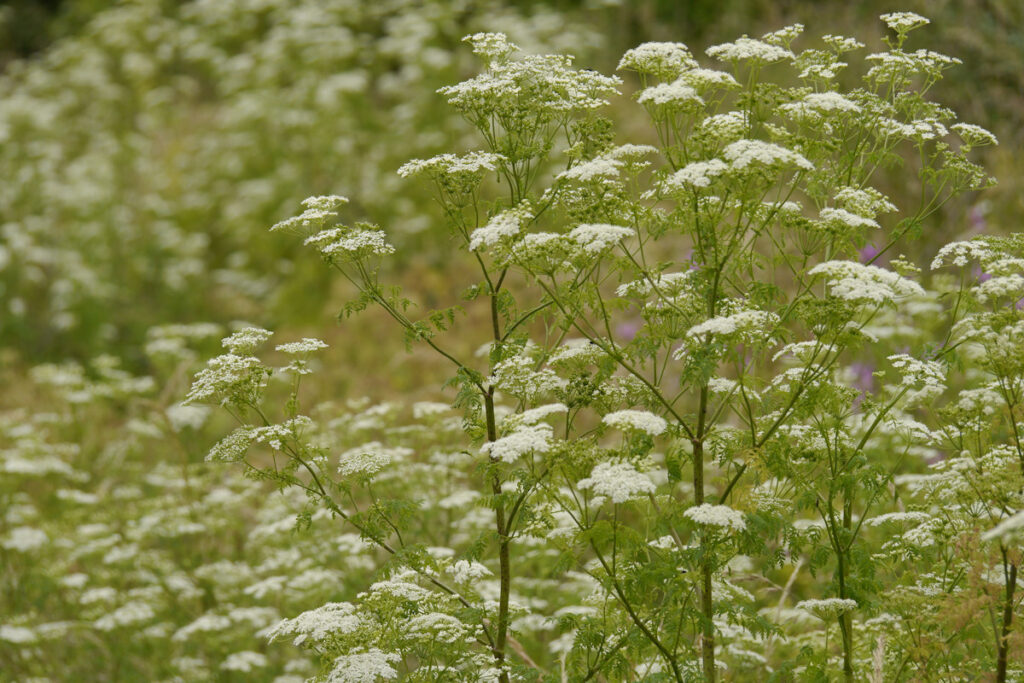
Photo by Joy Russell, via iNaturalist (CC BY 4.0).
From Rosette to Flowering Plant
Poison hemlock usually completes its life cycle over two years. In the first year, it forms a basal rosette—a low cluster of finely divided leaves.
In the second year, it typically sends up tall, branching stems and produces small white flowers in umbrella-shaped clusters. Plants commonly reach about six feet and can grow taller in favorable conditions.
After setting seed, the plant dies, though its dry stems may remain standing into winter. Seeds left behind can produce new plants, so a cleared patch needs follow-up checks.
Learn to recognize the rosette as well as the flowering plant. Earlier identification gives you more time to plan management before seed production.
Poison Hemlock & Queen Anne’s Lace
Both plants belong to the carrot family and have finely divided foliage and clusters of small white flowers. From a distance, they can look similar.
Start by observing the stems. Poison hemlock typically has hairless stems marked with purple blotches or streaks. Queen Anne’s lace (Daucus carota), also called wild carrot, has hairy stems that generally lack those markings.
Then compare the leaves and flowers. Poison hemlock’s foliage is hairless. Queen Anne’s lace often has a small dark red or purple flower at the center of the white flower cluster, but that flower is not always present.
Use several features together. A missing purple blotch or central flower does not settle the identification, especially on young plants.
Do not taste, crush, or break an unfamiliar plant to test its identity. These two species are only part of a larger group of similar-looking plants; if you’re uncertain, seek expert identification before handling or removal.
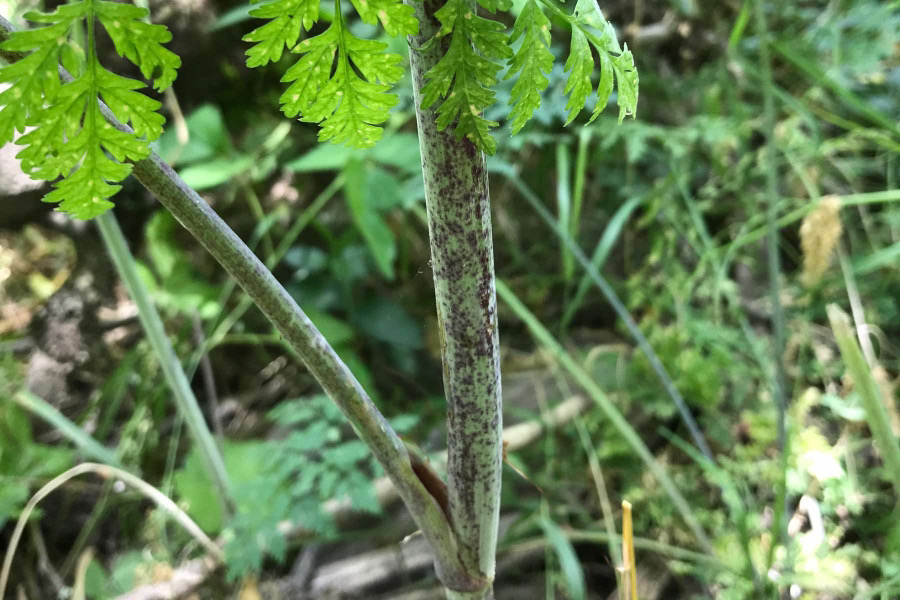
A Quick Field Comparison
No single characteristic should be used for identification. Use several clues together.
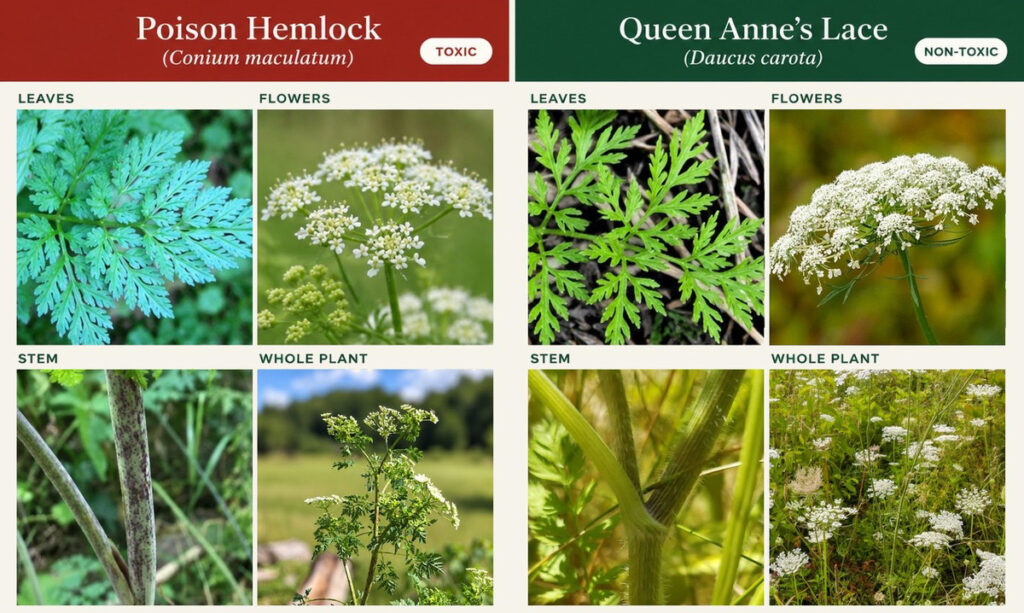
Use several features together. This table compares two species; it does not rule out other similar-looking plants.
| Poison Hemlock | Queen Anne’s Lace | |
|---|---|---|
| Stems | Hairless, hollow; typically with purple blotches or streaks | Hairy, green without purple blotches |
| Leaves | Finely divided; larger and more robust; hairless | Finely divided; generally more delicate and hairy |
| Flower clusters | Small white flowers in flat to slightly convex umbels | White umbels; often concave |
| Center flower | No characteristic dark central flower | Often a single dark reddish-purple flower |
| Mature Size | Often 3 – 8 ft | Generally much shorter |
| Odor – Do not crush plants to test odor | Musty/unpleasant when crushed | Carrot-like, particularly the root |
Features change with age and growing conditions. Young poison hemlock may not show the conspicuous stem markings of a mature plant.
Observe without tasting, crushing, or breaking the plant. If the features do not clearly agree, seek identification help before handling or removal.
Where It Shows Up
Poison hemlock often grows on disturbed ground along roadsides, ditches, creek banks, fence lines, and field edges. It favors moist conditions but can also survive on drier sites.
When walking a property, check these margins as well as pastures and areas where vegetation has recently been cleared. Look for low rosettes alongside taller flowering plants.
Location is a clue, not an identification. Confirm the plant’s features before deciding how to manage it.
Why It Matters
All parts of poison hemlock are toxic if eaten. Its alkaloids affect the nervous system and can cause paralysis, breathing failure, and death in people and animals.
Take particular care where children, pets, or livestock could reach it, and where plants might be gathered for food. Poisonings can occur when hemlock is mistaken for an edible plant or becomes mixed into forage, hay, or feed.
Ingestion is the main poisoning risk. Handling can also cause skin irritation in sensitive people, so avoid unnecessary contact and review precautions before removal.
Keep people and animals away from identified plants and cut material while arranging appropriate management.
Don’t Wait Until It Goes to Seed
Poison hemlock reproduces by seed, so preventing seed production is a central management goal. Confirm identification before beginning work.
For a small infestation, hand removal may be practical. Wear gloves, long sleeves, and eye protection, and avoid contact with sap. Remove the taproot while minimizing soil disturbance that could encourage more seedlings.
Do not burn plants or debris. Avoid casual mowing or string-trimming that could spray sap or scatter plant fragments. For larger patches, seek guidance on methods and precautions suited to the site.
Plan disposal before removal, keeping plant material away from children, pets, livestock, hay, and feed. Check local disposal requirements and return to inspect the area for new seedlings.
Before You Pull It
- Confirm identification. Compare several features and seek help if uncertain.
- Check access and exposure. Keep children, pets, and livestock away from the work area and removed material.
- Choose the method. Consider plant size, seed development, terrain, and the extent of the patch.
- Prepare for handling. Wear gloves, long sleeves, and eye protection, and avoid contact with sap.
- Arrange disposal. Check local requirements before cutting or pulling. Do not burn plants or debris.
- Plan follow-up. Inspect for seedlings and prevent new plants from producing seed.
If Poisoning is Suspected
If someone may have eaten poison hemlock, call Poison Control at 1-800-222-1222 immediately. Do not wait for symptoms or try to treat the exposure at home.
If the person has trouble breathing, collapses, has a seizure, or cannot be awakened, call 911 immediately.
If a pet or livestock may have eaten hemlock, contact a veterinarian immediately. Human Poison Control does not provide treatment guidance for animals.
The Landscape Lesson
Reading a landscape starts with noticing what grows where. A patch along a drainage ditch or on recently disturbed ground deserves a closer look before maintenance begins.
Observe the plant’s form, stems, leaves, and flowers without handling it. Compare several features and seek identification help when the details remain uncertain.
Knowing what you’re working with helps you choose the timing, methods, and precautions appropriate to the site.
Helpful Resources
-
UC Integrated Pest Management (UC IPM) — Poison Hemlock —
Identification, toxicity, life cycle, distribution, and management guidance for California. - California Invasive Plant Council (Cal-IPC) — Poison Hemlock —California invasive-plant assessment, distribution, impacts, and management resources.
-
Cal-IPC WeedMapper —
Known and modeled distribution of poison hemlock and other invasive plants in California. -
Los Angeles County Integrated Pest Management — Countywide IPM
Los Angeles County information on pest and weed management. -
Poison Control — Can Poison Hemlock Be Deadly?
For information about accidental exposure or ingestion and what to do if poisoning is suspected.
 Start the Conversation