
Field Notes · More Topics
When the Windows Stay Shut: Living With a High-Reactivity Cat
In my line of work, an open window often feels like the simplest choice: fresh air without running another machine. At home, my cat’s health complicates that instinct.
My cat has severe atopic dermatitis, and allergy testing reported strong reactions to every grass, weed, and tree pollen included on the panel. Keeping the windows closed is one way I try to limit pollen entering the house.
That has changed how I think about the indoor environment. Filtration, cleaning, ventilation, and plant choices all need to work together, alongside veterinary care.
When opening the windows stops being the right choice
This Cat’s Individual Test Results
HERBU, as printed on the original test. These are this cat’s individual results, not a general allergen ranking.
Grasses
Weeds
Trees
Right-end chevrons mark >600 HERBU: bars are capped at 600, not an exact measured value. Every source row prints +++; no cutoffs or severity are inferred from the numbers.
All Results — Data Table
| Category | Allergen | HERBU |
|---|---|---|
| Grasses | June grass (Kentucky Blue) | 545 |
| Grasses | Meadow Fescue grass | 500 |
| Grasses | Orchard grass | 410 |
| Grasses | Perennial Rye grass | 443 |
| Grasses | Red Top grass (Bent) | 390 |
| Grasses | Timothy grass | 424 |
| Grasses | Sweet Vernal grass | 449 |
| Grasses | Brome grass | 429 |
| Grasses | Oat pollen | 448 |
| Grasses | Johnson grass | 401 |
| Grasses | Bahia grass | 434 |
| Grasses | Corn pollen | >600 |
| Grasses | Bermuda grass | >600 |
| Weeds | Lamb's Quarters | 352 |
| Weeds | Kochia | 281 |
| Weeds | Russian Thistle | 512 |
| Weeds | Saltbush, Annual | 373 |
| Weeds | Ragweed Mix (Short, Tall) | 375 |
| Weeds | Ragweed, False | 355 |
| Weeds | Ragweed, Southern | 298 |
| Weeds | Ragweed, Western | 510 |
| Weeds | Sage, Mugwort Mix | 288 |
| Weeds | Cocklebur | 392 |
| Weeds | Marsh Elder, Burweed | 410 |
| Weeds | Marsh Elder, Rough | 436 |
| Weeds | Goldenrod | 418 |
| Weeds | Dog Fennel | >600 |
| Weeds | Sorrel, Dock Mix | >600 |
| Weeds | English Plantain | 292 |
| Weeds | Pigweed Mix | 296 |
| Weeds | Nettle | 257 |
| Trees | Maple, Box Elder Mix | 348 |
| Trees | Oak Mix | 428 |
| Trees | Beech | 563 |
| Trees | Mulberry | 326 |
| Trees | Hickory | 389 |
| Trees | Pecan | 352 |
| Trees | Walnut, Black | 370 |
| Trees | Walnut, California Black | 382 |
| Trees | Willow | 312 |
| Trees | Aspen | 327 |
| Trees | Cottonwood | 425 |
| Trees | Ash, American/White | 315 |
| Trees | Ash, Arizona | 382 |
| Trees | Olive | >600 |
| Trees | Privet | 454 |
| Trees | Cedar | 142 |
| Trees | Cypress, Arizona | 198 |
| Trees | Cypress, Bald | 458 |
| Trees | Elm Mix | 428 |
| Trees | Alder | 302 |
| Trees | Birch Mix | 264 |
| Trees | Hazelnut | 371 |
| Trees | Sycamore | 542 |
| Trees | Acacia | 473 |
| Trees | Mesquite | 453 |
| Trees | Sweetgum | 427 |
| Trees | Bayberry | 476 |
| Trees | Pepper Tree | 349 |
| Trees | Pine Mix | 439 |
| Trees | Palm, Queen | 502 |
| Trees | Eucalyptus | 100 |
| Trees | Melaleuca | 410 |
| Trees | Pine, Australian | 542 |
An open window connects the house to whatever is in the outdoor air. In my home, that means weighing fresh air against the pollen it may bring inside.
The results shown here belong to my cat. They record reactions to the allergens tested; they are not a general ranking of harmful plants or a measure of how severe each flare-up will be.
Keeping windows closed is one part of managing exposure. The next task is making sure the home still has adequate ventilation while reducing particles through filtration and regular cleaning.
Air purifiers that never stops
Air purifiers run in my home day and night. HEPA filters can capture airborne pollen, dust, and dander, but only from air that passes through the unit. They cannot remove particles already settled on bedding, floors, or furniture.
Choose a purifier with a clean air delivery rate, or CADR, suited to the room. Place it where your cat spends time, keeping the intake and outlet clear and following the manufacturer’s placement guidance.
Longer run times and higher fan speeds generally filter more air. Choose a setting you can comfortably keep running, and inspect and replace filters as directed.
Avoid devices that intentionally generate ozone. Filtration works alongside cleaning and adequate ventilation.
Closing the gaps
Keeping windows closed makes ventilation and routine cleaning more important. A few practical steps can help:
- Plan for filtered outdoor air. Ask a qualified HVAC professional about ventilation suited to your home, including filtered mechanical options. A portable purifier recirculates indoor air; it does not supply fresh air.
- Check the central filter. If you have forced-air heating or cooling, consider a MERV 13 filter if the system can accommodate it. Confirm compatibility and fit before upgrading.
- Reduce what comes through the door. Remove shoes, change pollen-covered clothing, and wash your hands before handling your cat.
- Clean where particles settle. Wash bedding regularly, damp-dust surfaces, and use a vacuum with effective particle filtration.
- Discuss coat care with your vet. Ask whether wiping your cat’s coat or paws would help and which methods are appropriate for their skin.
What plants can, and can’t, do for indoor air
Houseplants bring beauty, texture, and a connection to living things into a closed-window home. Those are good reasons to grow them.
Their reputation as air cleaners needs more context. Plants and microorganisms around their roots have removed certain airborne compounds in sealed laboratory chambers. That does not mean a few pots will meaningfully clean the air in an ordinary room.
Keeping the windows closed does not turn houseplants into an effective filtration system. For indoor air quality, focus on reducing pollutant sources, providing adequate ventilation, and filtering airborne particles.
In my home, plants earn their place through the pleasure of living with them.
Rethinking plants, inside and out
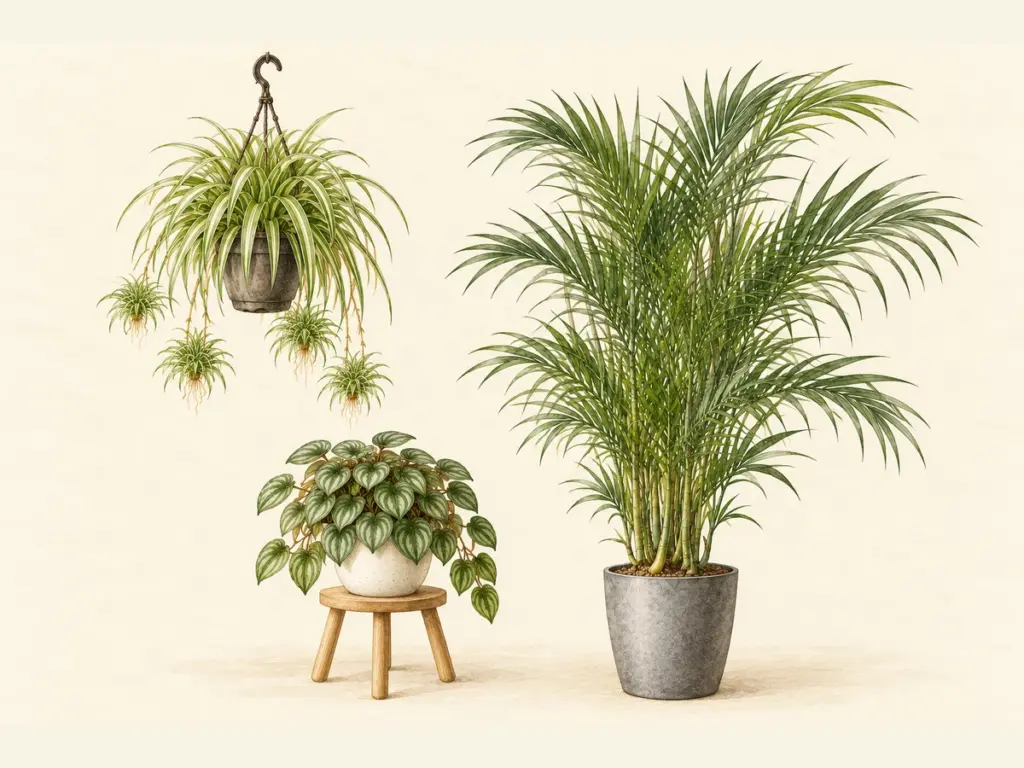
Indoors, I choose plants listed as non-toxic to cats, such as spider plant, Boston fern, and areca palm. Check the scientific name when buying: common names can refer to very different plants.
Non-toxic does not mean allergy-free, and chewing even a non-toxic plant can cause stomach upset. I also avoid indoor blooms as a precaution for my particular cat.
Choose plants suited to the available light, use pots with drainage, and water according to each species’ needs. Avoid leaving pots standing in water.
Outdoors, consider what grows beside windows, doors, and air intakes. Plant selection and placement may help reduce nearby pollen sources, but pollen also travels from beyond the property. Changes should reflect the site and your veterinarian’s interpretation of your cat’s history and test results.
A note on your cat’s health
Changes around the home can support your cat’s care, but persistent scratching, skin sores, or overgrooming need veterinary attention.
Allergy testing is one part of the picture. Your veterinarian interprets the results alongside symptoms, history, and the exclusion of other causes, and may use them to guide allergen-specific immunotherapy.
Keep a simple record of flare-ups and changes in the home or routine. It can help you and your vet assess what is happening without assuming every improvement or setback has a single cause.
Living with my cat has made sustainability a more personal, practical question: how do I create a home that uses resources thoughtfully and meets the needs of everyone living in it?
Helpful Resources
- ASPCA: https://www.aspca.org – list of toxic and non-toxic plants to cats.
 Start the Conversation